Bridge 101 - #0 (What is Bridge?)
I haven't been able to engage with bridge for a long time since I was introduced to it in 1st year of high school. To both recall what I know and learn new things, I decided to prepare a few articles.
What is Bridge?
Bridge is a sport based on tactical communication between partners and the rational use of the cards in hand. I call it a sport, even an Olympic sport. The International Olympic Committee (IOC) recognizes the World Bridge Federation1.
The goal of the game is for the attacking side to reach the contract, while the defending side aims to prevent that contract from being achieved.
I want to leave some links and start explaining the game.
World Bridge Federation: http://www.worldbridge.org/
Turkish Bridge Federation: https://www.tbricfed.org.tr/
Oyuna Hazırlık
Bridge is played by 4 people. These individuals sit opposite each other in pairs. The players sitting opposite each other are partners. The positions at the table are referred to by directions: North-South (N - S), East-West (E - W).
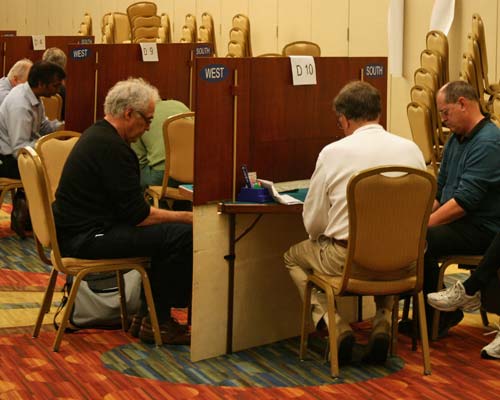
To play bridge, you need a standard deck of 52 cards. If you want to make things a bit more formal, you can also get a "bidding box" for the declaration phase. This way, you don't need to speak while deciding on your contract. It might be surprising, but during a game of bridge — except for some special cases — players never talk. In fact, at bridge tournaments, you might see cross panels designed to minimize communication between partners.
A lot of terms have been introduced, haven't they? Don't worry, we'll cover all of them.
As mentioned, bridge is played with a standard deck of cards. This deck contains a total of 52 cards, with 13 cards of each suit. As far as I know, bridge came to our country from France, which is why the French terms have been adopted. I might be mistaken.
The 4 suits in the deck are ranked in order of value, from the most valuable to the least valuable, as follows:
| Suits | In Bridge |
|---|---|
| ♠ Maça (Spades, Pikes) | ♠ Pik (Piques) |
| ♥ Kupa (Hearts) | ♥ Kör (cœurs) |
| ♦ Karo (Diamonds, Tiles) | ♦ Karo (Carreaux) |
| ♣ Sinek (Clubs, Clovers) | ♣ Trefl (Trèfles) |
The ranking of cards within each suit, from the highest to the lowest, is as follows: A, K, Q, J, 10, 9, 8, 7, 6, 5, 4, 3, 2.
| Cards | In Bridge |
|---|---|
| As (Ace) | As |
| Papaz (King) | Rua (Roi) |
| Kız (Queen, Lady) | Dam (Dame) |
| Vale (Jack, Knave) | Vale (Valet) |
Let's Get Started!
One of the 4 players takes the deck, shuffles it, and has the player on their right cut the deck. Then, starting with the player on their left, they deal the cards one by one. Each player receives 13 cards, and the entire 52-card deck is dealt. The player dealing the cards is called the dealer, and after the game is completed, the role of dealer passes to the player on the dealer's left. In other words, it moves clockwise. The game consists of two main phases: Declaration and Play (card play).
Declaration
After the dealing is complete, the bidding phase begins. We'll cover this in more detail later. There are hundreds, perhaps thousands, of books written on this phase. Just so you know :) To summarize briefly, the purpose of the bidding is to determine the trump suit and the contract (how many tricks will be won). This is one of the aspects that sets bridge apart from other games. During the bidding phase, partners can communicate only by stating their bids; they cannot communicate in any other way.
For now, we'll skip over the details of the bidding. Let's assume it has been completed and move on. The player who sets the contract starts the play. I know the concepts are increasing :)
About the Declaration
For more information about the declaration, you can refer to the bidding basics article.
Play
The player who set the contract starts by playing a card. The other players must play a card of the same suit as the one played, but they are not required to play a higher card. Each time all four players have played a card, a "trick" is completed. The player who played the highest card of the leading suit wins that trick. The player who wins the trick leads the next one, and this continues until all 13 tricks have been played.
Example Tricks
East wins and playes a new card.
South wins and playes a new card.
South wins and playes a new card.
Whether you are on the attacking or defending side, your goal is to win as many tricks as possible. The individual number of tricks you win does not matter. What's important is to win the most tricks with your partner. Tracking the cards is crucial here. For example, if you notice that your opponents have lost the king, and you have the ace while your partner has the queen, both the queen and the ace could potentially win tricks. However, if you play the ace over your partner's queen, you lose that opportunity.
We said that a trick is formed when each player plays a card. Therefore, in a game of bridge, there are a total of 13 tricks.
So, what if we don't have a card of the same suit? In that case, we will play any card at random (discard). However, if this card is not a trump, it cannot win the trick. We will discuss trump suits later. If the card played is not a trump, it is pointless to play a high card because it has no chance of winning the trick. Let's examine the following example hands, assuming that none of them are trump cards:
S -> Kör 5♥
W -> Kör 6♥
N -> Pik K♠ -> Anlamsız. Kör ile başlanmıştı. Löveyi kazanma şansı yok.
E -> Karo A♦ -> Anlamsız. Kör ile başlanmıştı. Löveyi kazanma şansı yok.
West wins and playes a new card.
Batı wins ans playes a new card. Note that the trick started with clubs. Which is the highest club on the table? Therefore, West wins this trick.
Trump Suit Concept
In bridge, games can be played either without a trump suit (No Trumps, NT) or with a trump suit. These decisions are made during the bidding phase. If you don't have any cards of the suit led, you can play a trump card. However, you are not required to play a trump card. BUT! If you have a card of the suit led, you must play it; you cannot play a trump card. If the first card played is a trump, you must also play a trump card, because you are required to follow the suit. If the first card played is a trump and you don't have any trump cards, you can play any of your smallest cards. Since you cannot win the trick, it doesn't matter which card you play.
When a trump card is played, it is referred to as "trumping", "overtrumping (not sure about the English terms, sorry). Once a trick is trumped, the importance of the other cards is diminished. The highest trump wins the trick.
Trump -> Pik♠
W -> Trefl 10♣
N -> Pik 3♠ (Trumped.)
E -> Trefl 5♣ (Will lose for sure, played a small card.)
S -> Trefl A♣ (If this was the only clubs it has, unfortunately, ace is lost.)
North wins and playes a new card. Because the highest trump on this play came from North. If South had a smaller club but still played the ace, that would be nonsense.
West wins. Because the highest trump came from West
In Summary
- The 52 cards are dealt equally to four players, with 13 cards each.
- The game progresses clockwise.
- Only one card is played per trick.
- You are required to play a card of the same suit (spades, hearts, diamonds, clubs) if you have one.
- There is no obligation to play a higher card.
- There is no obligation to play a trump card.
- The only condition for playing a trump card is that you do not have a card of the suit led.
- If there are no cards of the suit led, you may play any card, including a trump card.
- There are a total of 13 tricks.
- Your goal is to win the most tricks.
Bridge may seem like a simple card game at its core, but it is a sport that requires significant tactics, strategy, and effective communication. Proper communication between partners and logical use of the cards in hand are essential for winning.
There is no element of chance in bridge. In tournaments, cards are not dealt randomly. Every table and every participant plays with identically dealt cards. So, the North player at table 10 has the exact same cards as the North player at table 26.
Links
-
WORLD BRIDGE FEDERATION, https://www.olympic.org/world-bridge-federation ↩